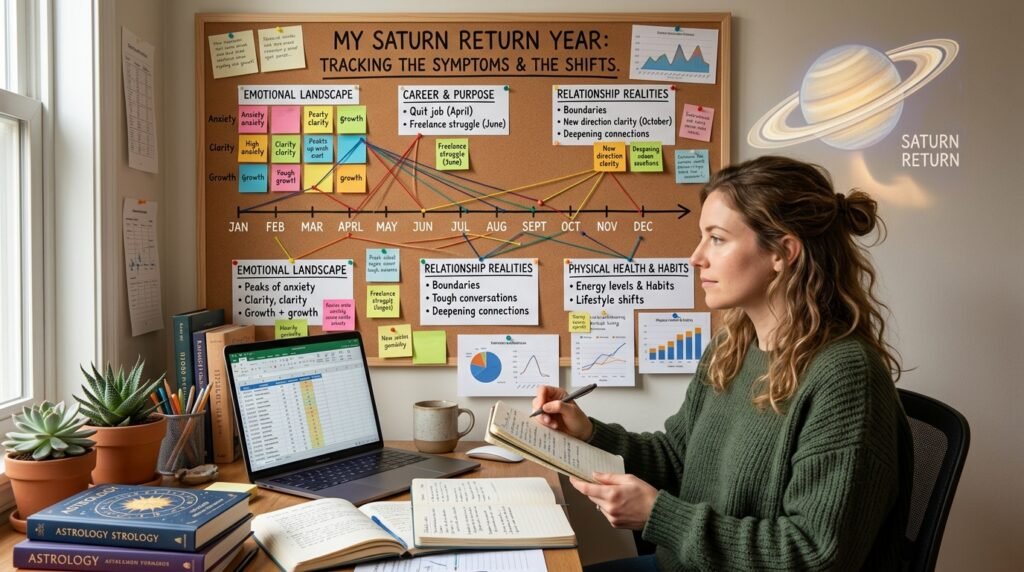

We’ve all heard the horror stories. In the world of astrology, the Saturn Return is often spoken about in hushed, panicked tones, usually accompanied by a glass of wine and a deep sense of impending doom. It’s the “quarter-life crisis” written in the stars—a cosmic audit that supposedly tears down your life and leaves you rebuilding from the ashes.
For years, I approached my upcoming Saturn Return with a mixture of academic curiosity and genuine anxiety. As an astrology researcher, I knew the theory: Saturn returns to the exact degree it occupied at your birth, demanding maturity, responsibility, and the shedding of anything that no longer serves your “Great Work.”
But theory is one thing; lived experience is another. So, I decided to do something a bit obsessive. I tracked every “symptom,” every mood shift, every career hiccup, and every structural change in my life for 365 days. I wanted to know if the dreaded Saturn Return symptoms were just confirmation bias or a legitimate celestial rite of passage.
What I discovered wasn’t exactly what the memes promised. It was quieter, heavier, and ultimately more transformative than I could have imagined.
What is a Saturn Return, Really?
Before diving into my logs, we need to strip away the “doom-scrolling” definitions. Saturn is the planet of boundaries, time ($chronos$), and structure. It takes roughly 29.5 years to orbit the sun. This means that between the ages of 27 and 30, Saturn comes back to where it was when you took your first breath.
In astrology, this is considered your “astrological adulthood.” If the first 30 years of your life are a rough draft, the Saturn Return is the editor who shows up with a red pen and starts crossing out the fluff.
The Common “Symptoms”
If you search for Saturn Return online, you’ll find a laundry list of symptoms:
- Sudden career pivots or job loss.
- The ending of long-term relationships.
- A feeling of “heavy” time or constant exhaustion.
- Deep existential dread about “running out of time.”
- Increased responsibilities (mortgages, promotions, or parenthood).
My Observation Phase: The Heavy Fog of Month One
I noticed right away that the “symptoms” didn’t start with a bang. There was no dramatic lightning strike. Instead, it felt like a slow increase in the “gravity” of my daily life.
During the first three months of my tracking, what surprised me was the physical manifestation of Saturnian energy. I felt old. Not in a biological sense, but in a skeletal sense. Saturn rules the bones, skin, and teeth. I found myself scheduling dentist appointments I’d ignored for years and suddenly caring about the ergonomics of my office chair.
In my experience, the early stage of a Saturn Return isn’t about the world changing; it’s about your tolerance for “good enough” disappearing. I couldn’t ignore the cracks in my foundation anymore.
The “Weight” of Time
I logged a recurring thought in my journal: “I am behind.” This is a classic Saturnian trap. Because Saturn is the Lord of Time, his return makes you acutely aware of your mortality. I felt like I had wasted my twenties, even though I had been objectively productive. This psychological pressure is the first real symptom—a tightening of the internal clock.
The Mid-Year Audit: Relationships and Career
By month six, the transit moved into its “active” phase. This is where the astrological transit usually gets its bad reputation.
The Relationship “Cull”
During my observation, I watched three distinct friendships fade into the background. There were no fights or dramatic blowouts. Instead, it was as if the “energetic contract” had simply expired.
I realized that Saturn doesn’t take things away; he simply stops supporting what isn’t structural. If a relationship is built on a shaky foundation of “party friends” or trauma-bonding, Saturn withdraws the glue. What I observed was a shift toward quality over quantity. I stopped wanting to go to loud bars and started wanting to have three-hour dinners with people who actually knew my middle name.
The Career Pivot
In the professional sphere, I noticed a strange phenomenon. I became incredibly frustrated with my lack of “expert” status. Saturn demands mastery. If you’ve been “faking it” in your career, the Saturn Return will make that impostor syndrome feel like a physical weight.
I saw this in my peers as well. One friend, a talented artist who had been working in marketing, suddenly quit to apprentice as a carpenter. That is a quintessential Saturn move: moving from the abstract to the concrete.
Real-Life Situations: The “Saturnian” Events
Throughout the year, I documented several “Saturn Events” that felt too specific to be coincidences. Here are a few examples of how this energy manifested:
- The “Final Warning” Health Check: About eight months in, I developed a repetitive strain injury in my wrist. It forced me to stop working for two weeks. Saturn is the planet of “No.” When I tried to push through it, the pain got worse. When I surrendered and learned a new way to work, the pain vanished. Lesson: Saturn rewards discipline, not burnout.
- The Financial Tightening: My income didn’t necessarily drop, but my expenses for “the future” increased. I felt an overwhelming urge to start a retirement fund and fix the leaky faucet I’d been ignoring. Saturn loves a budget.
- The Authority Shift: I had a major confrontation with a mentor. In my experience, the Saturn Return often involves a “killing of the king” moment—where you stop looking for external validation and realize you are the authority in your own life.
Lessons from the Year: What Saturn Taught Me
Tracking this year taught me that the “symptoms” of a Saturn Return are actually just the growing pains of a soul maturing. Here are the key takeaways from my year-long experiment:
1. Resistance is the Only Source of Pain
The people I observed who had the “worst” Saturn Returns were the ones fighting the hardest to keep things the same. If Saturn is trying to take a job away from you, and you’re white-knuckling the desk, it’s going to hurt. If you let go, the transition is remarkably smooth.
2. Saturn Rewards the “Boring” Work
Saturn is the planet of the “unsexy” win. He doesn’t care about your viral TikTok; he cares about whether you’ve paid your taxes and if you’re a person of your word. The days I felt the best were the days I followed a strict routine.
3. The “Heavy” Feeling is Grounding
We spend our twenties floating on potential. The Saturn Return is the “landing.” It feels heavy because you are finally putting your feet on the ground. It’s the difference between a balloon and a mountain.
Essential Survival Tips for Your Saturn Return
If you are currently entering your Saturn Return (roughly ages 27–30 or 57–60), here is what I recommend based on my year of tracking:
- Audit your “Shoulds”: Most of the anxiety comes from what you think you should have achieved. Cross them out. Ask what you must do instead.
- Check your bones and teeth: Seriously. Take the physical symptoms as a metaphor for your internal structure.
- Embrace the “No”: If a door closes, don’t try to pick the lock. Saturn is protecting you from a path that has no future for you.
- Find a Routine: Saturn loves a container. Give your life a shape—even if it’s just a consistent morning coffee ritual.
Conclusion: Life on the Other Side
As I reached the end of my 365-day tracking period, the “fog” finally began to lift. I didn’t feel like a completely different person, but I felt like a solid version of myself.
The most profound thing I noticed was a newfound sense of peace with “slow.” Before my Saturn Return, I was obsessed with speed and immediate results. Now, I understand that anything worth building takes time. Saturn gave me the gift of the long view.
Your Saturn Return isn’t a punishment; it’s an invitation to take yourself seriously. It’s the universe asking, “Who are you when the training wheels come off?”
If you’re feeling the weight right now, take a deep breath. The pressure is just the process of turning carbon into a diamond. You’re not falling behind; you’re finally arriving.